



























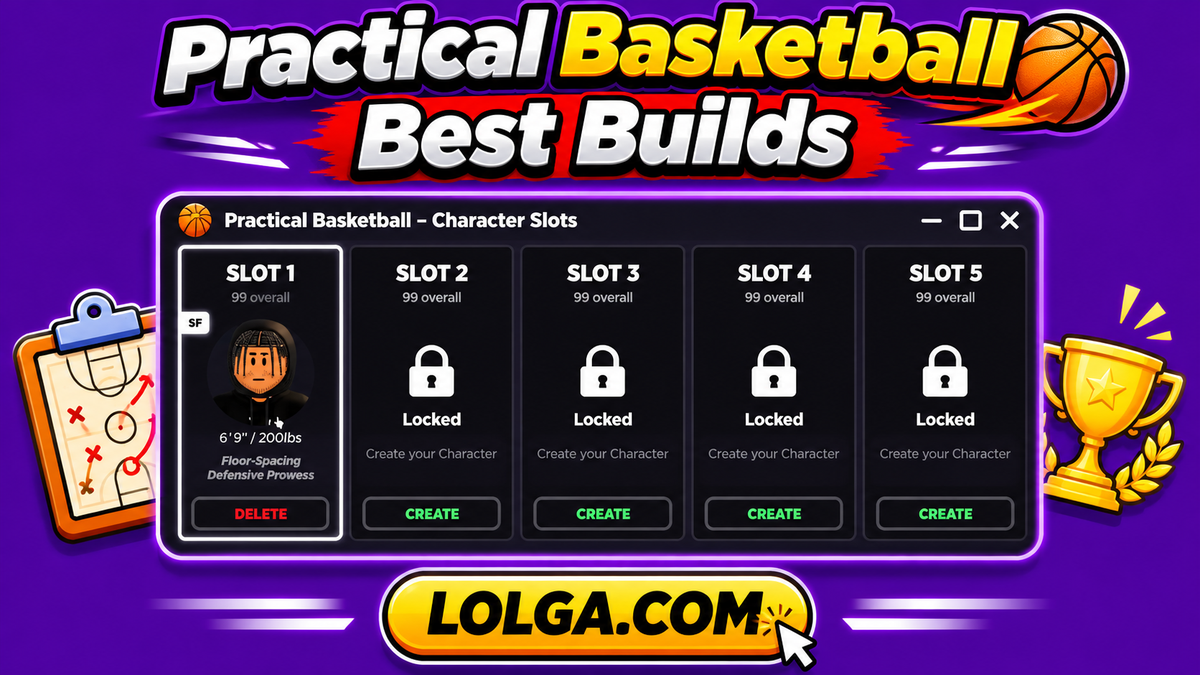
Compare five positions, detailed attribute templates, Takeovers, badges, strengths, and beginner-friendly options.
⚡ Quick Answer
For new players, a balanced 6'8" Small Forward is a sensible all-around starting point. Players who prefer three-point shooting can explore a 6'7" Shooting Guard, while rebound-focused players may prefer a 6'11" Center. The numerical templates below are historical community examples, not November Alpha builds verified in-game.
On this pageJump to section ↓
What Is the Best Build in Practical Basketball?
The best build depends on what you want to do in a match. Point Guards create plays, Shooting Guards provide perimeter offense, Small Forwards mix scoring and defense, Power Forwards offer physical finishing and help defense, and Centers control the paint and rebounds.
Alpha accuracy note: The following attribute spreads come from documented community builds from the 2026 stress-test period. Practical Basketball entered Alpha on October 30, 2026. Before spending currency or finalizing a character, open My Player and confirm the current attribute caps, badges and available animations.
Best Builds by Position – Quick Comparison
| Position | Community example | Best use | Suggested Takeover |
|---|---|---|---|
| PG | 6'2", 165 lbs | Playmaking, handles | Smooth Operator |
| SG | 6'7", 180 lbs | Three-pointers, spacing | Knockdown Shooter |
| SF | 6'8", 225 lbs | Balanced offense and defense | Highlight Reel |
| PF | 7'0", 230 lbs | Finishing and mobile defense | Glue Guy |
| C | 6'11", 290 lbs | Rebounds and rim protection | Board Hunter |
1. Best Small Forward Build – Balanced Two-Way Player
A versatile Small Forward (SF) is our beginner recommendation because it allows you to learn shooting, finishing and defense without taking every possession as the main ball handler.
Example SF attributes
| Setting | Community template |
|---|---|
| Position / size | Small Forward · 6'8" · 225 lbs |
| Driving Layup / Driving Dunk | 86 / 85 |
| Mid-Range / Three-Point Shot | 85 / 82 |
| Ball Handle | 80 |
| Perimeter Defense | 84 |
| Speed / Stamina | 85 / 91 |
| Takeover | Highlight Reel |
Why it works: It has enough outside offense to punish open defenders, enough finishing to attack the basket and enough perimeter defense to contribute on both ends. It does not require the same ball-handling workload as a small Point Guard.
Suggested badge focus: High Flyer, Gymnast, Quick Draw, Quick Handles, Locks and Intimidator, subject to availability and threshold requirements in your current build.
How to play: Take open looks, attack gaps after a teammate creates space and defend wings. Avoid spending all your Stamina on unnecessary dribbling.
2. Best Shooting Guard Build – Perimeter Scorer
If your favorite part of basketball is hitting three-pointers, choose a Shooting Guard (SG) template that prioritizes shooting ratings and movement.
Example SG attributes
| Setting | Community template |
|---|---|
| Position / size | Shooting Guard · 6'7" · 180 lbs |
| Mid-Range Shot | 95 |
| Three-Point Shot | 95 |
| Ball Handle | 86 |
| Perimeter Defense | 85 |
| Speed / Acceleration | 90 / 91 |
| Stamina | 90 |
| Takeover | Knockdown Shooter |
Why it works: Strong perimeter ratings support open catch-and-shoot attempts and shots created by simple movement. The player has enough mobility to stay involved defensively.
Suggested badge focus: Quick Draw, Limitless Shooter, Catch & Pop, Tunnel Vision and Space Maker.
Trade-off: This template gives up some interior finishing and all-around playmaking. A 95 Three-Point Shot does not turn every heavily contested attempt into a make—shot timing still matters.
3. Best Point Guard Build – Ball Handler and Playmaker
Point Guard is best suited to players who enjoy reading teammates, handling the ball and directing the offense.
Example PG attributes
| Setting | Community template |
|---|---|
| Position / size | Point Guard · 6'2" · 165 lbs |
| Ball Handle | 96 |
| Pass Accuracy | 96 |
| Mid-Range Shot | 93 |
| Three-Point Shot | 63 |
| Speed | 96 |
| Takeover | Smooth Operator |
Why it works: This particular pass-first template emphasizes speed, passing and controlled dribbling. It can create opportunities and play at a high tempo.
Suggested badge focus: Quick Handles, Tireless Handles, Quick Pass and Dimer.
Trade-off: With a relatively low 63 Three-Point Shot in the documented template, it is not the ideal option for a player whose main goal is deep shooting. Build a different scoring PG if that is your priority.
How to play: Use one crossover or stepback to create space, find the open teammate and avoid holding the ball until the shot clock becomes difficult.
4. Best Power Forward Build – Mobile Defensive Big
A Power Forward can supply screens, rebounds, finishing and defensive help without committing to a stationary Center role.
Example PF attributes
| Setting | Community template |
|---|---|
| Position / size | Power Forward · 7'0" · 230 lbs |
| Driving / Standing Dunk | 90 / 90 |
| Three-Point Shot | 81 |
| Perimeter Defense | 90 |
| Block / Rebound | 90 / 90 |
| Speed | 80 |
| Takeover | Glue Guy |
Why it works: The combination of physical finishing and solid defensive ratings supports versatile frontcourt play. Some outside shooting keeps opponents from ignoring the perimeter.
Suggested badge focus: Rebound Chaser, Rim Saver, High Flyer and Iron Screens.
Trade-off: This is not designed for guard-style dribble creation. Focus on smart positioning, screens and cuts instead of long isolation possessions.
5. Best Center Build – Rebounding and Rim Protection
If you prefer a physical role, Center (C) allows you to help by boxing out, protecting the basket and collecting second-chance possessions.
Example C attributes
| Setting | Community template |
|---|---|
| Position / size | Center · 6'11" · 290 lbs |
| Rebound | 97 |
| Block / Interior Defense | 87 / 84 |
| Strength | 88 |
| Standing Dunk | 85 |
| Post Control | 85 |
| Pass Accuracy | 81 |
| Takeover | Board Hunter |
Why it works: High rebounding and interior attributes support a clearly defined team role. Even when you are not the primary scorer, well-timed screens and defensive rebounds can change a match.
Suggested badge focus: Rebound Chaser, Rim Saver, Post Lockdown and Iron Screens.
Trade-off: Big builds are usually less comfortable on the perimeter, especially against quicker ball handlers. Defend intelligently instead of chasing every dribble move.
Which Build Should You Pick for Each Game Mode?
| Game mode | What matters most | Sensible direction |
|---|---|---|
| 1v1 | Shot creation and on-ball defense | Two-way wing or isolation guard |
| 2v2 | Complementary roles and spacing | Ball handler + defender/big |
| 3v3 | Versatility and defensive switching | Balanced SF with useful shooting |
| 5v5 | Team roles, rebounds and ball movement | Choose the position your team needs |
A historical S-tier Center is not necessarily the easiest 1v1 option, and a scoring guard is not necessarily the best addition to a team that already has several ball-dominant players.
How to Make Your Own Practical Basketball Build
- Choose your role first: primary scorer, playmaker, defensive wing or interior big.
- Pick height and weight carefully: larger builds gain reach but can sacrifice speed and handling.
- Check important animation requirements: do not buy a jumpshot or dunk animation your build cannot equip.
- Watch badge thresholds: a few points invested in an attribute can matter more if they unlock a relevant badge tier.
- Choose a matching Takeover: Knockdown Shooter for shooting, Smooth Operator for creation, Board Hunter for rebounding and so on.
- Practice before committing resources: use the Gym to learn shot timing and test basic movement.
Common Build Mistakes
Copying an outdated attribute screenshot. The game is in Alpha. Verify current caps and thresholds in the actual builder.
Trying to maximize everything. Specialization and useful role coverage are usually more valuable than spreading points without a plan.
Choosing a Takeover that does not fit your role. A rebound-oriented ability adds little if you spend the entire match outside the arc.
Ignoring defense and stamina. A player who scores a few extra points but cannot keep up defensively may hurt the team.